
Press Release
Drik Picture Library presents the Golam Kasem Daddy Lecture 2026
‘July 36: A museum in the making’
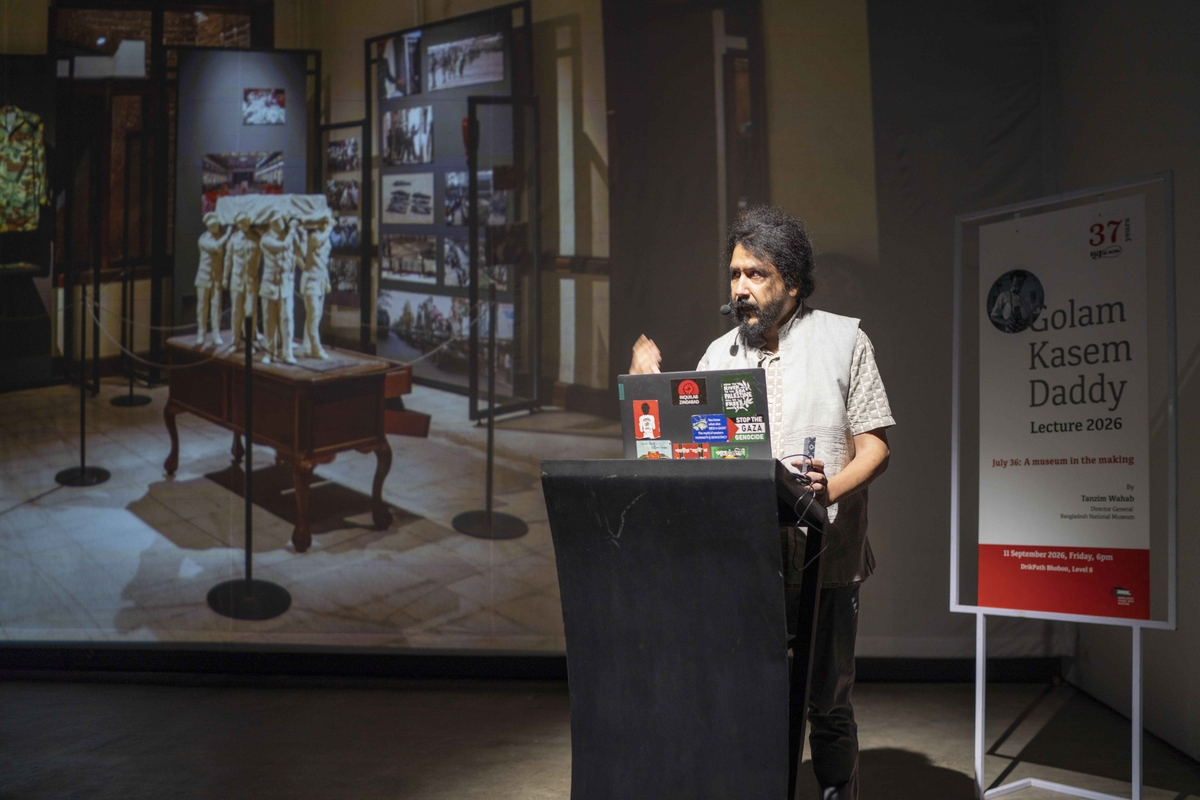
The Golam Kasem Daddy Lecture 2026, titled ‘July 36: A museum in the making’ was held earlier this evening at DrikPath Bhaban in Dhaka, organised by Drik Picture Library. The lecture was arranged as part of Drik’s 37th anniversary celebrations and was delivered by Tanzim Wahab, Director General of the Bangladesh National Museum.
At the beginning of the event, photographer, activist and Drik’s Managing Director Shahidul Alam paid tribute to Golam Kasem Daddy, highlighting his remarkable contribution to the history of photography in Bangladesh. He shared that since 2009, Drik has been organising this lecture series every year during its anniversary celebrations to honor Daddy’s memory and legacy. Beyond being a pioneering photographer, Golam Kasem Daddy was also a writer and lifelong learner. Even at the age of 101, he showed that curiosity and the desire to learn have no age limit by adopting email and new technologies.
Speaking about the evening’s speaker, Tanzim Wahab, Shahidul Alam recalled his journey from being a student of Pathshala South Asian Media Institute to becoming one of the country’s talented figures in photography and cultural practice. Through his creative vision, dedication, and continuous work as a photographer, Tanzim has gone on to take on the role of Director General of the Bangladesh National Museum.
Over the years, the Golam Kasem Daddy Lecture series has brought together many respected voices from different fields. Among those who have delivered lectures are artist and professor Dhaly Al Mamun, filmmaker Catherine Masud, artist and professor Lalarukh Selim, Palestinian writer and essayist Adania Shibli, researcher and scientist Professor Sayeedur Rahman, artist Mustafa Monowar, journalist and writer Nurul Kabir, and Muntasir Marai, Manager of Media Initiatives at the international news organization Al Jazeera, along with many other notable personalities. He expressed Drik’s joy and honor in welcoming Tanzim Wahab as the speaker for this year’s lecture.
Tanzim Wahab described how the former prime minister’s residence, Ganabhaban, was transformed into the July Mass Uprising Memorial Museum. He explained why the change mattered, how it was carried out, and how the museum seeks to preserve the pain, sacrifice, and experiences of ordinary people as part of Bangladesh’s collective national memory.
At the entrance, visitors see a line that captures the museum’s purpose: ‘Memory’s struggle against forgetting.’ Wahab said the museum was not built out of nostalgia. It was created as an act of resistance, a place where the country can confront and reflect on the actions of the state.
He recalled how the ‘Long March to Dhaka’ in July 2024 later turned into the ‘Long March to Ganabhaban.’ Ganabhaban had become a symbol of public anger and unanswered questions. People wanted to know whether it had been only Sheikh Hasina’s residence or whether it had also played a wider role in state affairs. They also wondered whether the building held evidence of repression and wrongdoing by the government.
When they first took responsibility for the site, they found it badly damaged. The walls were covered in graffiti, while thousands of documents and torn pieces of records were scattered across the floors. The team began by collecting, scanning, and preserving these materials to build an archive. Later, in coordination with the International Tribunal, the collection developed into an important historical record.
Wahab said the project was designed as more than a conventional museum. It is intended to be a memorial: a space that honours those killed, injured, and affected during the July Mass Uprising, while also documenting the 16-year rise and fall of a fascist government.
The upper floor contains personal belongings, audio recordings, videos, and photographs connected to the July uprising and its participants. The lower floor tells the stories of people affected by enforced disappearances, killings, and other violence under the previous government. It also includes memories of the BDR massacre and testimonies and reconstructions related to the Aynaghar.
Each section has its own theme and emotional focus. Wahab stressed that the museum is still a work in progress, continuing to collect stories and preserve evidence so that these experiences are not forgotten. He added that every part of the museum has been shaped by its own ideas, emotions, and themes, and that the work is far from finished. The museum is still evolving as new stories, materials, and perspectives are added.
To make it more welcoming and useful to the public, the museum has also been developed as a venue for seminars, talks, discussions, and cultural programmes. Thousands of visitors come every day, many of them school students, to see the exhibits and learn about the country’s experience of authoritarian rule and fascism.
Wahab also spoke about some of the museum’s limitations. One idea was to establish a “healing room,” a quiet, supportive space for people affected by years of loss, violence, and trauma. The aim was to recognise the emotional impact of these experiences and offer something that could contribute to visitors’ mental well-being. Although the idea has not yet been put into practice, discussions about it are continuing.
He also described some of the difficult questions that arose while the museum was being developed. During the interim government’s tenure, there was a proposal to include a section on Felani’s killing and other border killings. However, this led to a broader question by the current government: since such killings have continued since 1971, would it be appropriate to present them only within the museum’s focus on the previous 16 years? In the end, the proposal was dropped.
Security remains another concern. Wahab said the current arrangements are still inadequate, especially given the sensitive nature of the museum’s collection. Many of the young students and researchers who helped build the museum continue to work there as volunteers, but they have not yet been formally appointed as staff. As a result, important documents, testimonies, and exhibits remain vulnerable. Discussions are ongoing on how to strengthen protection and establish a more permanent team.
In closing, Wahab said he sees the museum as a project still in progress. With more staff, better planning, and the addition of new themes and initiatives, he believes the 17-acre site can grow into a stronger and more meaningful national memorial.
The lecture was delivered in Bengali and streamed live on Drik’s Facebook page.
Facebook Live link: https://www.facebook.com/Drik.bd/videos/1400915768840711
Press Release both English and Bengali: 20260911_ Press Release_Golam Kasem Daddy Lecture 2026_ ENG_ BNG.pdf
Photo Link: 20260911_ Photos_ Golam Kasem Daddy Lecture 2026
Photo: Habibul Haque/Drik
For further information, please contact:
Amina Neyamat
Equality, Diversity and Communications Officer
Mobile: +8801786502671, Email: amina@drik.net
OR
Parvez Ahmad Rony
Team Leader, Drik Images and Network Coordinator
Mobile: +8801737758800, Email: parvez@drik.net